
BlogSpecification guide
Private label cleaning chemicals: what the spec sheet, SDS and label must cover
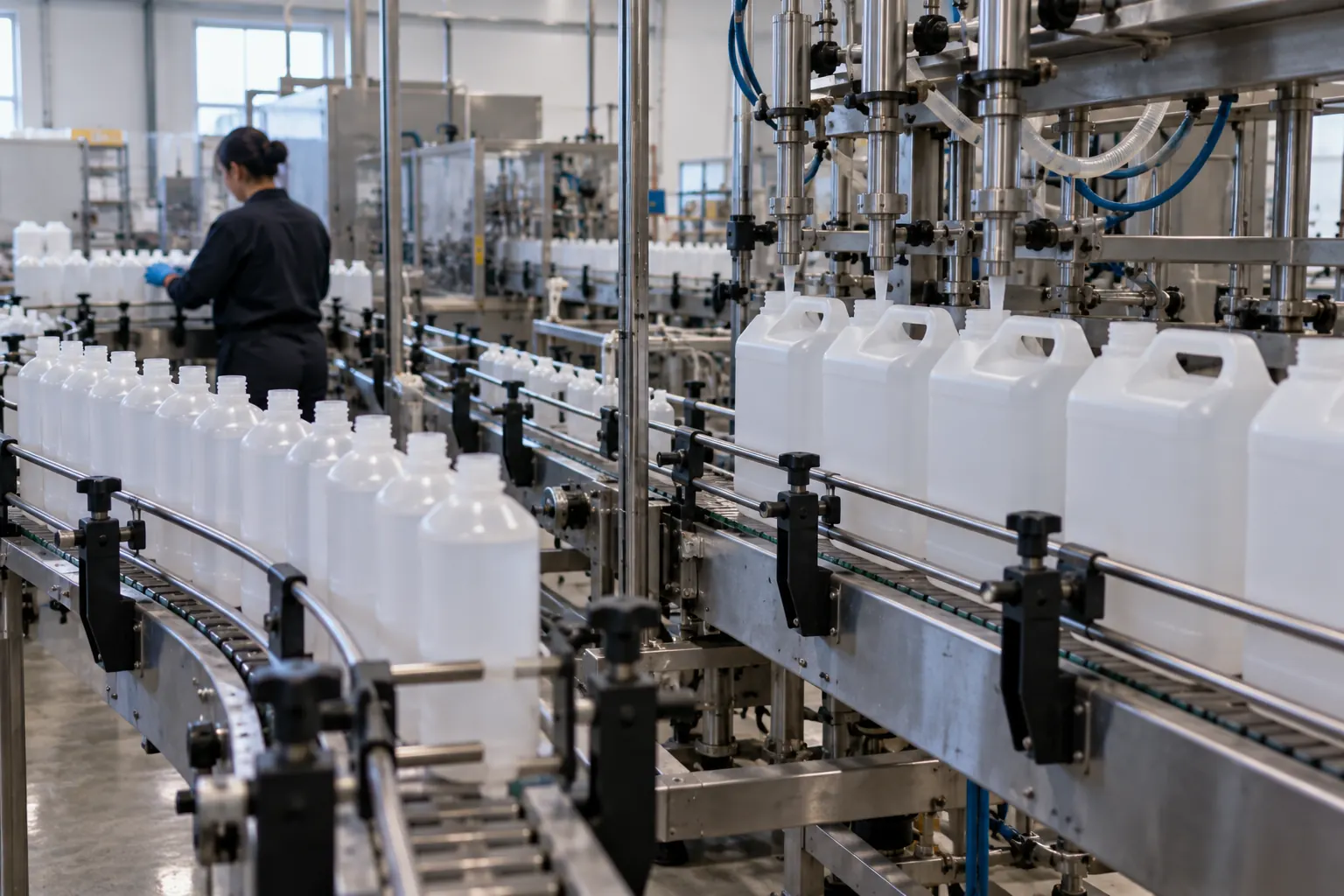
A paper spec is checked by a laboratory. A cleaning chemical is checked by the laboratory, and again by whoever answers the phone when a cleaner splashes it in their eye. That is why an own brand chemical line carries three documents rather than one: the product specification, the safety data sheet and the label. This guide covers what each has to say, and what a distributor should ask the manufacturer before a single bottle is filled.
Three documents, one liquid
The specification describes what is in the bottle and how it performs. The safety data sheet describes what it can do to a person or a drain and what to do about it. The label is the short version of both, printed where the user can see it. The first job of any buyer is to check that they agree. A pictogram on the label that the SDS does not justify means somebody wrote one document without reading the others.
Our guide to reading a tissue spec sheet applies one test to every line: could someone measure this? Chemicals add a second: does a regulator have a view on it?
The product specification, line by line
Concentrate or ready to use. Everything else hangs off this line. A concentrate is diluted by the user, which changes the pack size, the cost per litre in use, the dosing equipment your customer needs and, often, the hazard classification, since the concentrate is usually the more hazardous of the two. The spec must say which it is.
Dilution ratio, stated by the maker. For a concentrate, the ratio has to come from the manufacturer, in writing, per application. A floor cleaner may carry one ratio for mopping and another for machine scrubbing. The ratio is a cost claim, because your customer's cost in use is the concentrate price divided by the litres it makes. Ask for the ratio the laboratory validated.
pH range. pH tells you what family the product belongs to. Acidic products descale and alkaline products cut grease. A neutral product is for daily use on surfaces that neither should touch. State pH as a range for the product as supplied and, for a concentrate, at the recommended dilution, since the two can sit in different bands. A single number with no tolerance is a target. A missing pH line means the maker has not committed to a formulation family.
Active ingredient class. You will not get the formulation and should not expect it. What you should get is the class of active: anionic or non ionic surfactant, chelating agent, alkaline builder, acid, solvent. The class tells you what the product will and will not remove, and the classified ingredients on the SDS have to be consistent with it. "Proprietary blend" on its own tells you nothing you can check.
Fragrance and dye. State whether the product is fragranced, which fragrance, and whether it is coloured. Fragrance components can carry their own labelling obligations, and a colour code across a range has to be reproducible run to run. The word blue does not survive a second production; ask for a colour reference.
Viscosity. Viscosity decides how the product pours and how it doses through a pump or a dilution unit. It also decides whether the product clings to a vertical surface. Ask for a range with the method, or at least a stated target. If your customers dose through equipment, viscosity decides whether the product is compatible with it.
Pack sizes and closures. The bottom of the sheet is where the logistics live: pack size in millilitres or litres, bottle shape and neck size, closure type, units per case, case dimensions and weight, cases per pallet and per container. Chemicals are heavy where paper is bulky, so the freight arithmetic runs on kilograms. The fields on our cleaning chemicals line page follow this list.
The safety data sheet
The SDS has sixteen sections in a fixed order, following the UN Globally Harmonised System. The United States Occupational Safety and Health Administration publishes a public brief on the format under its Hazard Communication Standard. The headings run from identification and hazards through composition, first aid, handling and storage, exposure controls and physical properties, to disposal, transport and regulatory information. In the United Kingdom the SDS is required under UK REACH and the Health and Safety Executive publishes guidance on it; the European Union uses the same structure under EU REACH.
Four sections carry most of the weight for a buyer. Section 2 gives the hazard classification and the label elements the product must carry. Section 3 lists the ingredients that drive it. Section 9 gives the physical and chemical properties, where the pH and viscosity on your spec should reappear. Section 16 states when the sheet was issued or revised. A sheet with no revision date, or one years old on a product whose formulation has moved, is the first thing to check on any enquiry.
Ask for the SDS written for the market you sell in. Sections 2, 8 and 15 refer to that jurisdiction's classification lists, exposure limits and regulations, so a sheet for one market does not automatically serve another. "We have an SDS" is not the same as "we have an SDS for your market".
The label, and why it must match the SDS
In Great Britain the label of a hazardous mixture is governed by GB CLP, which the HSE describes as the EU CLP Regulation assimilated into GB law, so that Great Britain continues to apply the GHS independently of the European Union. In the EU the CLP Regulation applies directly. Under both, a product classified as hazardous carries hazard pictograms, a signal word, hazard statements and precautionary statements, and the HSE is explicit that the pictograms and the wording that supports them are set out in law and must be used where hazardous properties have been identified. The hazard statements are fixed by the classification.
This is where the documents have to agree. The classification in Section 2 of the SDS determines the pictograms and statements on the label. If the label carries a corrosion pictogram and the SDS says irritant, one of them is wrong, and your name is on the bottle. Check every pictogram, the signal word and every statement against Section 2 before you approve the label.
A second obligation catches many distributors when they move from selling a brand to owning one. In the European Union, Annex VIII to the CLP Regulation, introduced by Commission Regulation (EU) 2017/542, requires harmonised information on hazardous mixtures to be submitted for emergency health response, and where a unique formula identifier (UFI) is created it must be printed or affixed on the label, clearly visible, legible and indelibly marked. Scope, thresholds and dates depend on classification and use category, so check the current text for the product you actually sell. In Great Britain the position differs: the National Poisons Information Service states that GB based importers and downstream users are encouraged to voluntarily submit information on hazardous mixtures placed on the GB market, using the safety data sheet, and that there is no obligation to generate or submit a UFI in Great Britain, though it will register a product with one if it exists. Northern Ireland is treated differently from Great Britain, so check the current position if you supply it. If you sell into both the EU and Great Britain, plan for both.
The party responsible for the label is the one placing the product on the market under its own name. That is you. The manufacturer should supply the classification and the draft label elements, but the obligation does not travel with the invoice.
Claims to keep off the label
Any claim that a product sanitises or disinfects is regulated separately in the United Kingdom, the European Union and the United States, and a general purpose cleaner does not become a disinfectant because the label says so. We do not quote disinfectant or sanitiser claims, and we would keep them off an own brand label unless the product has been through the relevant regime and the manufacturer can show the paperwork. The same caution applies to non toxic, eco, biodegradable and safe, each of which has either a defined meaning or a regulator with a view on it.
What to ask the manufacturer
- Concentrate or ready to use, and if a concentrate, the validated dilution ratio per application.
- pH range as supplied and at the recommended dilution.
- The class of active, and what that means for what the product will and will not clean.
- Fragrance and colour, and whether both can be reproduced on the next run.
- Viscosity range and method, and suitability for the dosing equipment your customers use.
- A safety data sheet written for your market, with a current revision date.
- Whether Section 2 of the SDS matches the draft label, pictogram for pictogram and statement for statement.
- For the EU, whether the mixture has been notified under Annex VIII and carries a UFI; for Great Britain, whether information has gone to the NPIS.
- Which claims on the draft label the manufacturer can support with documents, and which should come off.
- Pack size, closure, units per case, case weight, cases per pallet and per container, in writing.
A manufacturer who can answer all ten in writing is one you can build a range with. One who answers the first and the last and goes quiet in between has not finished developing the product.
Where Millgate fits
Millgate runs own brand cleaning chemicals alongside hygiene paper on European production, consolidated into one container and invoiced from a US company, for distributors in the United States, the United Kingdom and the Caribbean. Paper runs at one mill and chemicals at a second plant. Every chemical line is quoted against a written specification. If you want to know whether a particular format, pH band or pack size is available, ask for the spec and we will send it. If your first order mixes paper and chemicals, our guide to your first private label container covers how the two categories travel together.