
BlogSourcing guide
Finding a centrefeed roll manufacturer
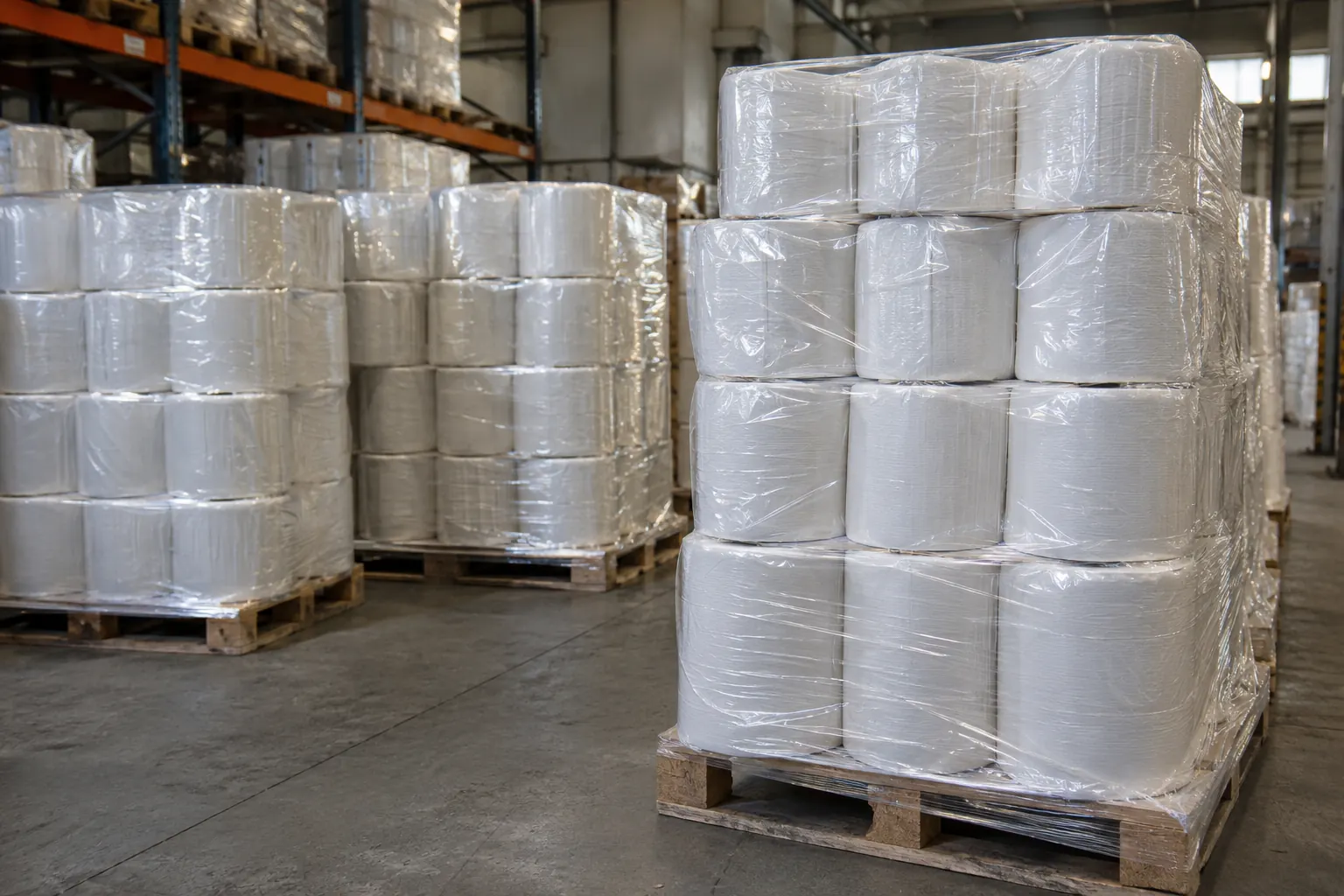
Centrefeed is the workhorse of British wiping paper: the blue or white roll pulled from the middle, mounted in a wall dispenser or dropped on a workshop bench. Most distributors buy it three tiers down from the machine that made it. This guide covers what changes when you go to the source, and what a centrefeed spec has to pin down before anyone can quote it honestly.
What centrefeed actually is
A centrefeed roll dispenses from the centre rather than the outside, so it can sit in a simple open dispenser and be pulled one handed. The format dominates catering kitchens, workshops and food production floors in the United Kingdom and Ireland. It is sold overwhelmingly in two colours: white for food adjacent and front of house work, and the blue roll that British trades treat as a category of its own, coloured so that any torn fragment is visible in a food environment.
The specification that decides the price
Two centrefeed rolls can look identical on a shelf and be a long way apart in real cost. The variables that matter:
- Ply and grammage. Most volume is two ply. The grammage per ply decides hand feel, wet strength and how fast the roll disappears from the dispenser.
- Roll length, stated in metres. This is the number wholesalers quietly shave. A case of six rolls at 120 metres is not comparable to a case of six at 150 metres, and sheet counts printed on the wrapper do not always survive a tape measure.
- Perforation. Perforated rolls tear to a sheet, unperforated rolls tear where the user pulls. Kitchens usually want perforation, workshops often do not care and should not pay for it.
- Core and roll diameter. The dispenser aperture decides both. A roll wound too fat will not drop into the dispenser your customer already screwed to the wall.
- Pulp basis. Recycled fibre is the usual basis for blue roll. Virgin fibre buys brightness and wet strength where the application justifies it.
Why the supply chain has so many layers
The UK centrefeed market is served by a small number of domestic mills and a large volume of imported product, passing through importers, national wholesalers and regional distributors before it reaches the end user. Each layer exists for a reason, holding stock or extending credit, but each also takes margin on a product that is mostly air and paper. In our experience, once own brand volume passes roughly a container a quarter, the arithmetic of going to the source usually clears the cost of holding the stock.
Going to the source with your own label
An own brand centrefeed programme needs the one page specification above, your label artwork, and a decision about case count. From there the questions are the same as any imported paper line: what does the container load, in cases, what documentation accompanies the shipment, and who invoices you. Because centrefeed is bulky and cheap per kilogram, the container loading figure dominates the landed cost, and a supplier who winds tighter or cases smarter is handing you margin.
Where Millgate fits
Millgate runs own brand centrefeed alongside folded towel, toilet tissue and cleaning chemicals on European production, consolidated into one container and invoiced from a US company, for distributors in the United States, the United Kingdom and the Caribbean. If you buy centrefeed from a wholesaler today, send us the label off one case and we will quote the same roll at manufacturer terms.